
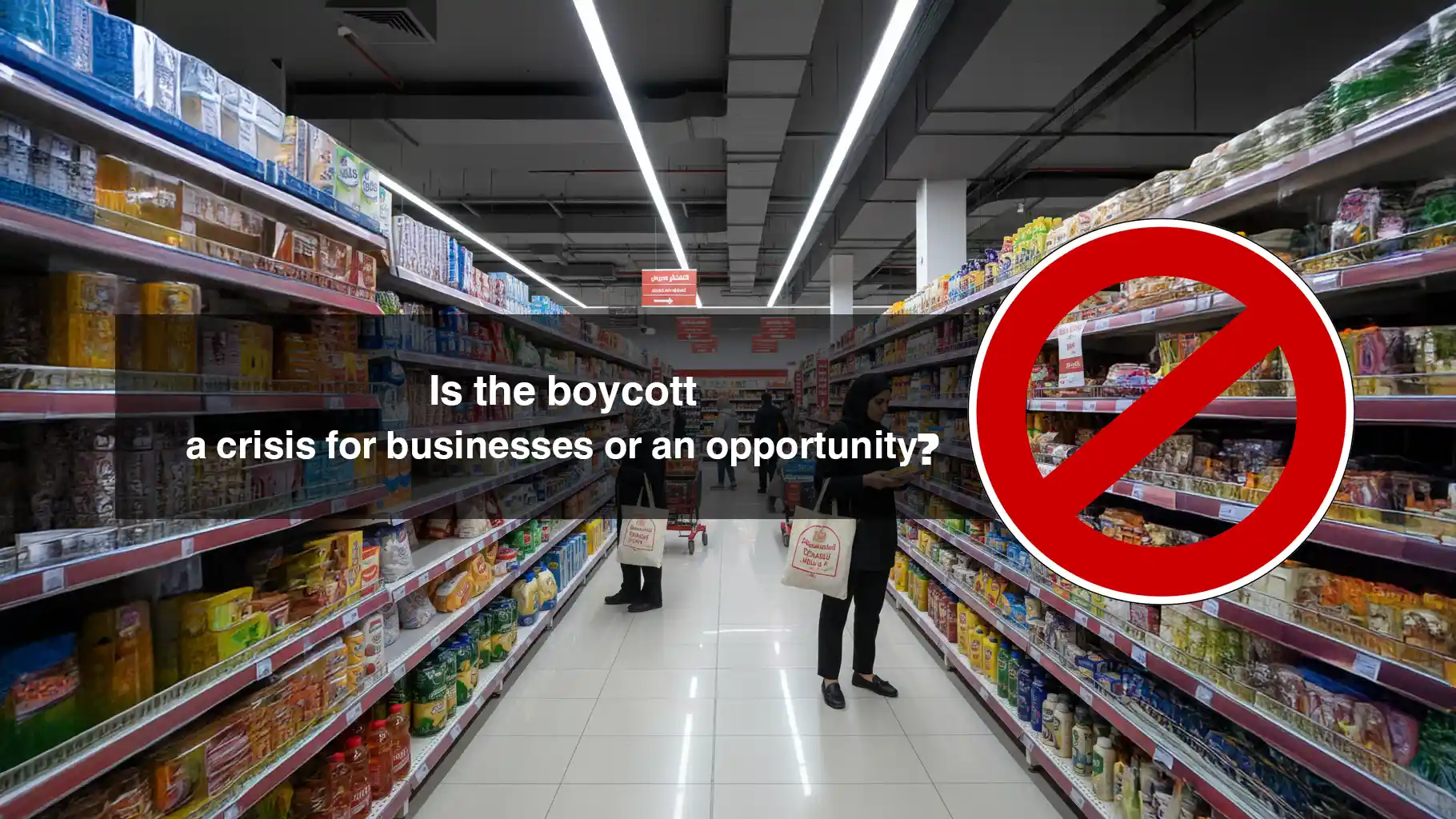
A Comprehensive Look at the Latest Boycott Movement in Egypt and Support for Palestine
Since October 2023, following the escalation of the war on Gaza, Egypt witnessed one of the largest boycott waves in its modern history.
A movement that was not a “two-day trend” on social media, nor a seasonal call,
but a complete shift in consumer behavior that affected millions and reshaped the balance of power between international and local brands.
People began asking themselves:
“Where is my money going? And do I have the right to reward or punish a company through my purchases?”
A large grassroots movement emerged — embraced by youth, families, homemakers, and even small businesses that sometimes used it as a marketing angle.
And the major question that has remained alive until very recently is:
Was the boycott a crisis for businesses… or an opportunity no one noticed?
Let’s break it down step by step and see who was affected, who benefited, why, and what the Egyptian market truly revealed.
1. When Did the Boycott Start, and Why Did It Spread So Quickly?
The wave began after 7 October 2023, when events in Gaza escalated dramatically.
Within just 24 hours, social media was filled with hashtags like:
-
#Boycott
-
#Support_Egyptian_Products
-
#مقاطعة
At first, it looked like typical online activism…
but what followed was the real surprise.
Consumers actually changed their buying behavior:
-
Global restaurant chains became noticeably empty
-
Coffee chains that were always crowded turned quiet
-
Certain products were avoided entirely
-
Meanwhile… Egyptian products hit record sales not seen for years
The boycott wasn’t “organized” or directed by any authority —
it was a genuine, emotional, public reaction, and that’s what made it powerful and fast.
2. Who Was Actually Affected? With Names… and Verified Global Sources
One common mistake is speaking in general terms:
“Companies were affected”… “Companies weren’t affected.”
No — we need to name the brands that were impacted and understand how.
McDonald’s
The parent company officially stated in its 2024 quarterly earnings report:
“The Middle East region has seen a significant impact due to boycotts and conflict-related disruptions.”
In Egypt, the signs were clear:
-
Branches that were always full became half empty
-
Heavy promotions were launched to compensate
-
Advertising tone shifted to a defensive approach
Even though the Egyptian franchise does not publish public numbers,
market behavior said everything.
Starbucks
Probably the most targeted brand in the entire boycott wave.
Starbucks admitted in 2024:
“Boycotts driven by misinformation significantly impacted our performance in the region.”
Globally, the company lost over $11 billion in market cap, according to CNBC and Yahoo Finance.
In Egypt:
-
Many branches no longer had queues
-
Customers shifted toward Egyptian coffee brands like:
30 North – Brown Nose – Qahwa
Coca-Cola & PepsiCo
Coca-Cola announced that the Middle East region experienced “unusual decline” in demand at the end of 2023.
Local Egyptian alternatives like Fi Cola and Spiro Spathis saw enormous growth.
Pepsi was less directly targeted but still affected due to general avoidance of foreign brands.
3. Local Brands That Won Big — With Names
Spiro Spathis
One of the clearest success stories of the boycott.
Al-Ahram English reported that sales increased by 300–350% during the boycott.
The product even disappeared from shelves due to the sudden spike in demand.
Cook Door
Gained significant momentum as a “trusted Egyptian alternative” while international fast-food chains declined.
Egyptian Coffee Brands
Such as:
-
Brown Nose
-
30 North
-
Seven Fortunes
-
Qahwa
People shifted loyalty away from Starbucks to local premium brands —
some of which were barely known before the boycott.
4. So… Was the Boycott a Crisis or an Opportunity?
A balanced answer is:
The boycott is not a crisis — unless your business has a weak foundation.
And it’s not an opportunity — unless your business is ready to grow.
It was a stress test — and stress tests always reveal the truth.
When Does the Boycott Become a Crisis?
-
If your business relies on brand loyalty, not real quality
-
If your reaction is defensive, aggressive, or dismissive
-
If your product is easily replaceable
When Does It Become an Opportunity?
-
If your business is local and offers real quality
-
If your communication is respectful and intelligent
-
If the market is actively searching for alternatives
Which is exactly what happened in Egypt.
5. Why Aren’t There Official Boycott Figures for Egypt?
Because:
Most foreign brands in Egypt operate through franchise systems.
Meaning:
-
Losses occur inside Egypt
-
But the parent company is not required to publish country-specific numbers
-
Figures get blended into the Middle East region
So the absence of official data doesn’t mean “no losses”…
it simply means the losses weren’t disclosed.
Yet the market indicators clearly say:
Consumer loyalty shifted, and local brands gained ground.
6. Has Egyptian Consumer Behavior Really Changed?
Studies show:
-
Up to 96% of respondents participated in the boycott in some form
-
Over 70% said they would continue even after the war
-
UNDP reported over 100 local companies directly benefited
The biggest cultural shift:
People now ask:
-
Where is my money going?
-
What value am I receiving?
-
What is this brand’s position on my cause?
This is not a temporary trend…
It is a long-term behavioral change — far more impactful.
7. How Should Companies Respond During a Boycott?
Global experience shows:
-
Businesses that respect people’s emotions win
-
Those that ignore them lose
-
Those that attack or mock customers collapse
People are not demanding political statements.
They want respect, transparency, and social responsibility.
8. The Bottom Line — The Boycott Exposed… It Didn’t Destroy
The boycott wasn’t the end of any business.
It was the end of an old market era.
What happened in 2023–2024 resulted in:
-
A new distribution of loyalty
-
A rise in local brands
-
A decline of certain global brands
-
A stronger culture of “my money reflects my stance.”
The boycott acted like a mirror, revealing:
-
Who is truly strong
-
Who is respectful
-
Who delivers real quality
-
And who was relying solely on a big name without real value
And as it turns out…
The Egyptian consumer is far more aware and discerning than many companies ever expected.
Leave A Comment